
AI Design to Reality:
How Wicked Wraps Brings Your Vision to Life
You already know what you want your fleet to look like. The challenge is getting from the idea in your head to a finished wrap on the road — without compromise, miscommunication, or costly surprises.
That journey is where most wrap projects go wrong. A customer describes a concept, a designer interprets it, a printer prints it, and an installer installs it — each step adding distance from the original vision. By the time the vehicle rolls out, it looks close to what you wanted. Close isn’t good enough.
In This Story
Ready to Build Your Brand?
Your vehicle can be your business card, billboard, and first impression. Start with a consultation at Wicked Wraps in Mukilteo, WA.
Wicked Wraps has spent nearly two decades solving this problem. Based in Mukilteo, Washington, the company has built its reputation on closing the gap between concept and execution — bringing fleet branding visions to life with precision, speed, and craftsmanship that is increasingly rare in the vehicle wrap industry.
This is how they do it.
The Problem With the Traditional Wrap Process
Most vehicle wrap shops follow a fragmented workflow. Design happens at one desk. Printing happens somewhere else — sometimes outsourced entirely. Installation is handled by whoever is available that week, often a subcontractor who has never seen the design files until the day of the job.
This creates predictable problems:
- Design intent gets lost between handoffs. The installer doesn’t know what the designer was trying to achieve, so they make field decisions that alter the final look.
- Color matching drifts when printing is outsourced. Different printers, different calibrations, different results.
- Accountability disappears. When something goes wrong, the designer blames the printer, the printer blames the installer, and the customer is left holding the bag.
The result is a wrap that looks acceptable from twenty feet away but falls apart under scrutiny. For a business investing thousands of dollars per vehicle, acceptable is a poor return.
One Roof, One Team, One Standard
Wicked Wraps took a different approach. Since opening in 2005, the shop has kept every stage of the process under one roof in Mukilteo. Design, printing, and installation are all handled by the same team, in the same facility, using the same equipment and materials.
This is not a convenience. It is a quality control system.
When the designer who created your fleet concept is standing ten feet from the printer running the vinyl, color accuracy is not a hope — it is a standard. When the installer is part of the same team that reviewed your design proofs, the finished product matches the rendering because the person laying the vinyl already knows what the finished panel is supposed to communicate.
The Wicked Wraps team holds manufacturer certifications from Avery Dennison and STEK — two of the most recognized names in vinyl film and surface protection. Avery Dennison certification requires installers to demonstrate proficiency with the manufacturer’s specific materials through structured training and testing. STEK certification follows a similar standard for paint protection film and specialty vinyl products. The shop also reports PGITA (Professional Graphic and Installation Technologies Association) certification, though this credential is less widely recognized in the industry than established programs like PDAA (Professional Decal Application Alliance) Master Certification or 3M’s Preferred Graphics Installer program. What matters for fleet customers is that the people handling your vehicles have been trained and verified by the manufacturers of the materials they are working with.
From Concept to Vehicle: The Design Process
The design phase is where the vision either survives or dies. Wicked Wraps has refined a process that keeps the customer’s intent intact from first conversation to final panel.
Step 1: Discovery
Before a single pixel is pushed, the design team needs to understand the business behind the vehicle. What does the company do? Who are their customers? What neighborhoods do they serve? What do they want people to feel when the van pulls up?
A plumber serving upscale residential neighborhoods needs a different visual language than a food truck serving festival crowds. A fleet of ten delivery vans needs a consistent system that works across different vehicle sizes and shapes. These decisions shape the design from the beginning.
Step 2: Digital Design and Visualization
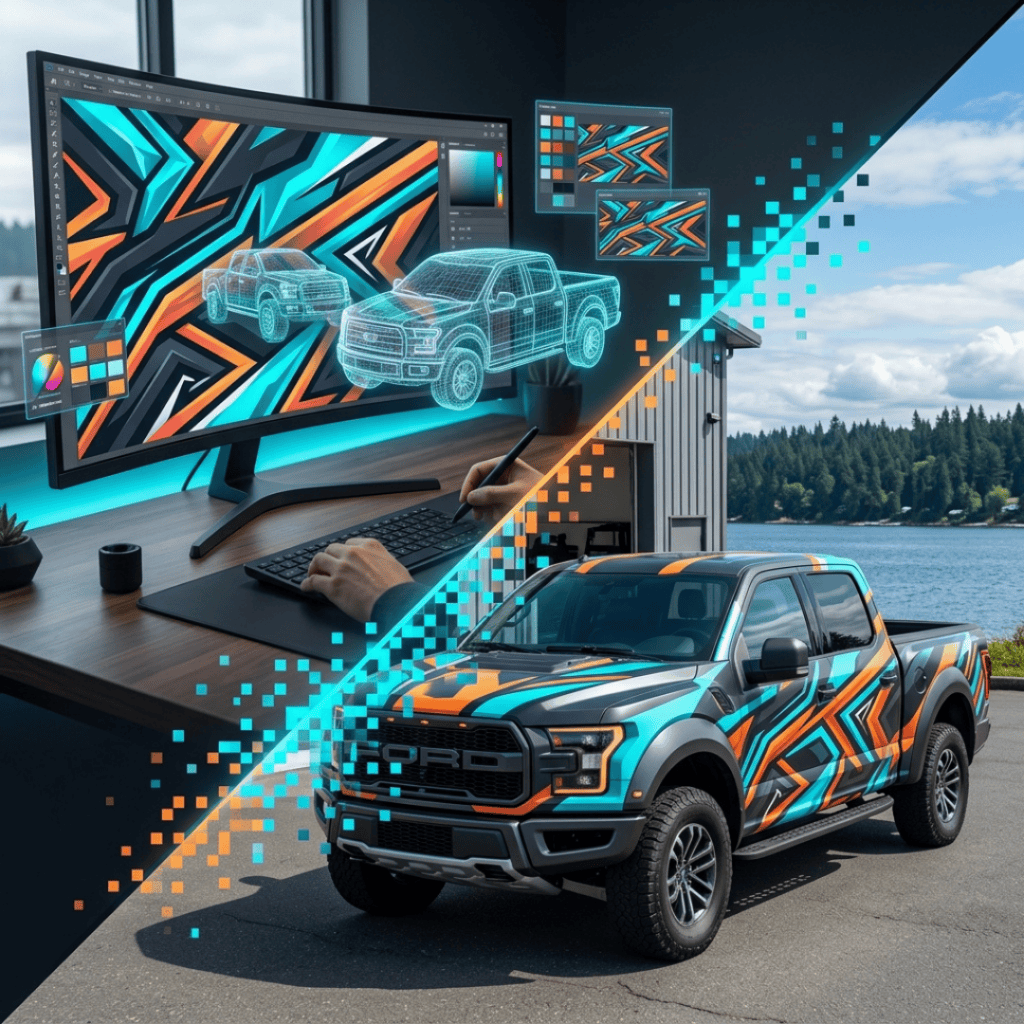
Modern vehicle wrap design relies on digital rendering tools that allow the customer to see their vehicle transformed before any vinyl is cut. Using vector-based design software, the Wicked Wraps team creates full-scale digital proofs that show exactly how the graphics will lay on the specific make and model of the customer’s vehicle.
This matters more than most people realize. A design that looks perfect on a flat monitor can fail on a three-dimensional vehicle. Curves, door seams, handles, and contours all affect how the eye reads the graphics. Digital rendering catches these issues early — before the investment in printing and installation.
According to Wicked Wraps, the design phase includes up to three revision rounds before printing begins. This reflects the reality that fleet branding is a collaboration — the customer knows their brand, the designer knows what works on a vehicle, and revisions are where those two kinds of expertise meet.
Step 3: Printing In-House
Once the design is approved, it moves to print — in the same building. Wicked Wraps uses high-resolution printing equipment calibrated to match the colors specified in the design file. Because the printer is in-house, the team can verify output against the approved proof before any vinyl reaches the installation bay.
The shop uses Avery Dennison certified vinyl, a material chosen for its durability, color fidelity, and conformability. Cheap vinyl looks good on day one and peels by month six. Premium vinyl, installed correctly, maintains its appearance for five to seven years — the lifespan Wicked Wraps quotes on every project.
Step 4: Professional Installation
This is where certification matters most. A perfectly designed, perfectly printed wrap can be ruined by a poor installation. Bubbles, lifted edges, misaligned panels, and stretched graphics are all installation failures — not design failures.
Wicked Wraps’ installers are certified by Avery Dennison and STEK. That means they have been trained on the specific techniques required for fleet-grade installation: working with complex curves, handling rivets and recesses, managing vinyl tension, and ensuring clean seams that hold up to weather and road conditions. For context, manufacturer-certified installers like those credentialed through 3M’s Preferred Graphics Installer program or PDAA Master Certification undergo rigorous hands-on testing to verify these skills — a standard that separates professional shops from casual operators.
Fleet jobs are prioritized. For businesses operating five or more vehicles, Wicked Wraps offers fleet discounts and coordinated scheduling to minimize downtime.
Step 5: Quality Control and Delivery
Before a vehicle is returned to the customer, it goes through a quality control check. Every panel is inspected. Every seam is reviewed. If something does not meet the shop’s standard, it is corrected before the customer sees the vehicle.
This is the advantage of an all-in-house operation. There is no one to blame. There is only one team, one standard, and one reputation on the line.
Why This Process Matters for Your Business
A vehicle wrap is not a purchase. It is an investment in brand visibility that compounds over years. According to data compiled by the Out of Home Advertising Association of America (OAAA), 88% of adults noticed an out-of-home ad within the past 30 days, and out-of-home advertising generates nearly four times more online activations per dollar than TV, radio, or print. Vehicle wraps specifically rank among the most noticed moving formats of OOH advertising, with studies finding that a single wrapped vehicle can generate tens of thousands of impressions per day.
The cost of a fleet wrap is a fraction of what most businesses spend on advertising channels that stop working the moment the budget runs out. A wrap keeps generating impressions every day the vehicle is on the road — in the exact neighborhoods where the business operates.
But that investment only pays off if the wrap is done right. A wrap that fades, peels, or looks amateurish does the opposite of its purpose. It tells potential customers that the business cuts corners.
The process Wicked Wraps has built — in-house design, in-house printing, certified installation, quality control — exists to protect that investment. It ensures that the vision you started with is the vision that ends up on the road.
Built to Last
Wicked Wraps has been serving Pacific Northwest businesses since 2005. That longevity is not an accident. In an industry with low barriers to entry and high turnover, the shops that survive are the ones that deliver consistent quality, build relationships with fleet customers, and stand behind their work.
The company’s client roster tells the story. Dickson Electric has been a fleet client for over ten years. Trophy Cupcakes, Glamr Garage, Bequest Coffee Co., Vector Pest Control — businesses across different industries that all chose to come back for additional vehicles rather than shop around.
As one fleet customer put it:
“Wade and his team at Wicked Wraps are nothing but the best! We have had 10 commercial vans wrapped as well as two Teslas. All look outstanding!! We won’t go anywhere else!”
— Dickson Electric, Fleet Client, 10+ Years
That kind of retention only happens when the first wrap meets expectations.
Ready to See Your Vision on the Road?
If you have a fleet — whether it’s one truck or fifty — the process starts the same way. Tell Wicked Wraps about your vehicles, your brand, and what you want to achieve. You will get a detailed proposal and pricing within 24 hours.
Get a fleet wrap quote within 24 hours and take the first step from concept to road-ready. The design team is ready when you are.